Since its beginnings in the 18th and 19th centuries, chemistry has been divided into two main branches: organic chemistry and inorganic chemistry.
- Organic Chemistry: It was associated with the chemistry of living beings and the substances related to them. It was thought that organic substances could only be synthesized by living beings because, in order to prepare organic compounds, something that only living beings possessed, the vital force, was needed.
- Inorganic Chemistry: It was associated with inert substances. It comprised the rest of chemistry other than chemistry related to living beings.
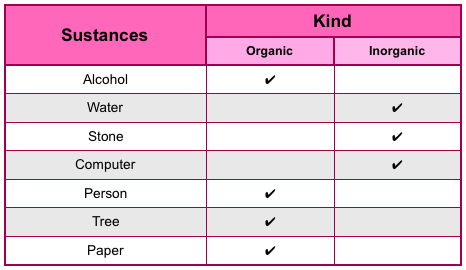
Nowadays Organic Chemistry is also called as “the Chemistry of carbon compounds” (not necessarily of living beings), studying the preparation, reactivated, properties and structures of these types of compounds. Some examples or organic and inorganic substances are:

Bioprofe | The chemistry of carbon | 01
Watch the video:

Organic Chemistry is based on: research (biochemistry, medicine, pharmacology, food, etc.), industrial chemistry, fossil fuels, etc. Organic compounds are much more numerous than inorganics, of which we can highlight, among others:
- Substances of biological interest: The bioelements, which are the chemical elements that are part of living things in greater proportion, are grouped into molecules common to all living beings or immediate principles: nucleotides, amino acids, monosaccharides and / or fatty acids. They are molecules such as drugs, poisons, medicines, insecticides, preservatives, etc.,
- Substances of industrial interes: Polymers formed by monomers, which are equal units that are repeated in large quantities. There are natural and artificial polymers. They are used as: plastics, textiles, glues, insulators, glass, etc. Other organic substances of industrial interest are: detergents, cosmetics, perfumes, additives, etc.
- Substances of energetic interest: The combustion of oil, coal, natural gas or wood, allow the extraction of usable energy and raw materials.
Fundamental properties of organic compounds
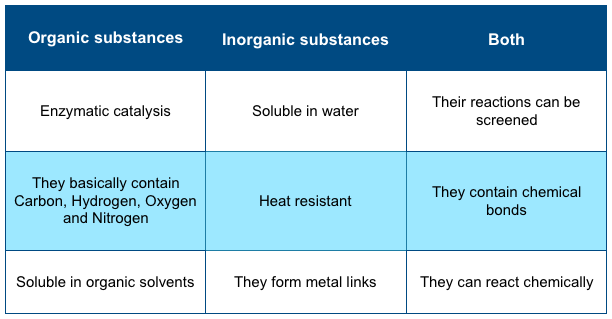
The main properties of organic compounds can be collected in:
- The are part of the living bienes or of the substancies related to them (they contain the following chemical elements: CHONPS)
- Its intramolecular bonds are covalent and the intermolecular bonds are hydrogen bridges or Van der Waals forces.
- Most are insoluble in water and soluble in organic solvents.
- Most are desatured by heat and burn easily.
- Their reations tend to be slow, having th break very stable bonds.
- In their reactions secondary reactions and variable yields usually take place.
- Your reactions can be channeled by enzymes.
Depending on the properties, the substances can be classified into:

Bioprofe | The chemistry of carbon | 02
Basic elements of organic compounds
Organic compounds have as a fundamental element carbon, a tetravalent element (which forms four covalent bonds) that can form chains of variable length and branching. These chains, in addition usually contain hydrogen. Hence, organic compounds are formed by hydrocarbon chains (carbon and hydrogen)
Besides tres atoes, the organic compounds can contain other atoms, called heteroatoms, being the most frequent: oxygen, nitrogen, halogens, sulfur and phosphorus, although they can contain other elements.


Bioprofe | The chemistry of carbon | 03
The carbon atom
The carbon ato has six protons and six electrons (Z=6). Its natural isotopes are:


Bioprofe | La química del carbono | 04
Its electrónica configuration shows that there are 4 electores in its last layer (1s2 2s2 2p2), missing another 4 to complete it (full layer configuration (1s2 2s2 2p6). To do this, it could gain or lose 4 electrons, which is too much. Therefore, carbon tends to share 4 electrons through covalent bonds.
The types of links can be:
- Simple: they share a pair of electrons.
- Doubles: they share two pairs of electrons.
- Triples: they share three pairs of electrons.
- Aromatics: they are special links and can be considered intermediate between the single and double bounds.
| Number and type of link | Representation | Geometry |
|---|---|---|
| 4 simple |
 Bioprofe | The chemistry of carbon | 05 |
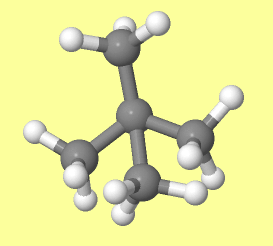 Bioprofe | The chemistry of carbon | 06 Tetrahedral (109’5º) |
| 1 double y 2 simple |
 Bioprofe | The chemistry of carbon | 07 |
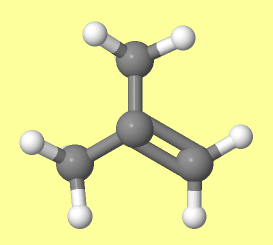 Bioprofe | The chemistry of carbon | 08 Triangular (120º) |
| 2 double |
 Bioprofe | The chemistry of carbon | 09 |
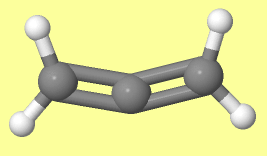 Bioprofe | The chemistry of carbon | 10 Linear (180º) |
| 1 triple y 1 simple |
 Bioprofe | The chemistry of carbon | 11 |
 Bioprofe | The chemistry of carbon | 12 Linear (180º) |
| Aromátic 3 simple y 2 double media |
 Bioprofe | The chemistry of carbon | 13 |
 Bioprofe | The chemistry of carbon | 14 Rectangular hexagon (120º) |


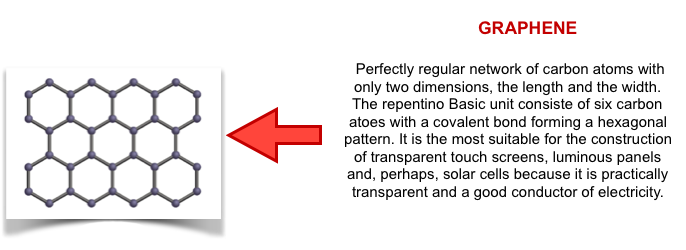
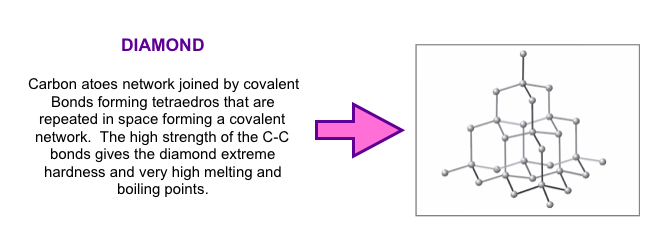
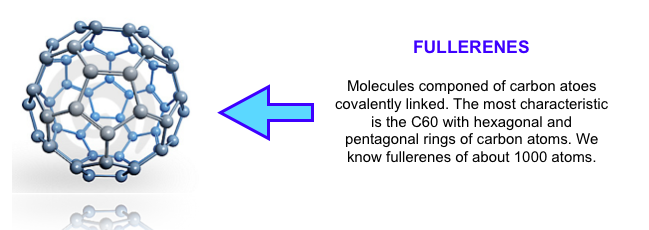
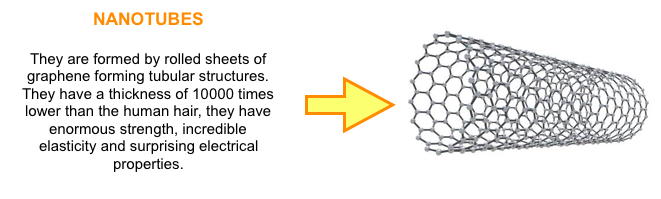
Carbon, at room teperature, is a solid, and depending on the way it has been formed, it has different forms in nature, known as “allotropic forms”.
In the alotropy of carbon, five forms are known, without including the amorphous carbon, and are: graphite, graphene, diamond, fullerenes and nanotubes.


Bioprofe | The chemistry of carbon | 15

Bioprofe | The chemistry of carbon | 16

Bioprofe | The chemistry of carbon | 17

Bioprofe | The chemistry of carbon | 18

Bioprofe | The chemistry of carbon | 19
Hydrogen and heteroatoms
Hydrogen is the second fundamental element in organic compounds. It has only one electron and, given its electronic configuration, it can only form a simple covalent bond.
The rest of the atoms that are not carbon or hydrogen are called heteroatoms. The most common are: oxygen, nitrogen, halogens, sulfur, phosphorus and nitrogen (although they may contain others.
The number, type and geometry of the bends that make up the atoms that join the carbon depend on their electronic configuration, are shown in the following table:
| ÁTOMS | CONFIGURATION | Nº AND TYPES OF LINKS | GEOMETRY |
|---|---|---|---|
| H | 1s1 | 1 simple |
 Bioprofe | The chemistry of carbon | 20 Linear (180º) |
| F, Cl, Br, I | ns2np5 | 1 simple |
 Bioprofe | The chemistry of carbon | 21 Linear (180º) |
| O, S, Se, Te | ns2np4 | 2 simple |
 Bioprofe | The chemistry of carbon | 22 Angular (105º) |
| 1 double |
 Bioprofe | The chemistry of carbon | 23 Linear (180º) |
||
| N, P | ns2np3 | 3 simple |
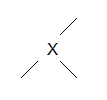 Bioprofe | The chemistry of carbon | 24 Trigonal pyramid (107º) |
| 1 double y 1 simple |
 Bioprofe | The chemistry of carbon | 25 Angular (115º) |
||
| 1 triple |
 Bioprofe | The chemistry of carbon | 26 Linear (180º) |
||
| Si, Ge | ns2np2 | 4 simple |
 Bioprofe | The chemistry of carbon | 27 Tetrahedral (109,5º) |


The greater the link order is (triple:3, double:2, simple:1), the smaller is the link length.
When an organic compound contains in its structure one or more metallic elements it is called “organometallic” compound.
Functional group
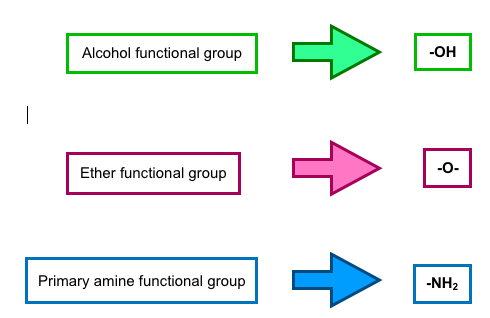
A “functional group” is a set of atoms, linked in a certain way, that have a estructure and determine physical-chemical properties that characterize the organic compounds that contain them. For example:

Bioprofe | The chemistry of carbon | 28
An organic compound has carbon and hydrogen chaina to which one or more funcional groups can be attached or inserted:
- Several funcional groups may exist in a compound. Their physical and Chemical properties will be determines fundamentally by them.
- There are many functional groups of atoms that can replace hydrogen in a chain of hydrocarbons and these groups can appear together in the same carbon chain, hence the great diversity of organic compounds. And is that carbon, along with just 10 other elements, forms more substances than the other 90 different elements of the periodic table.
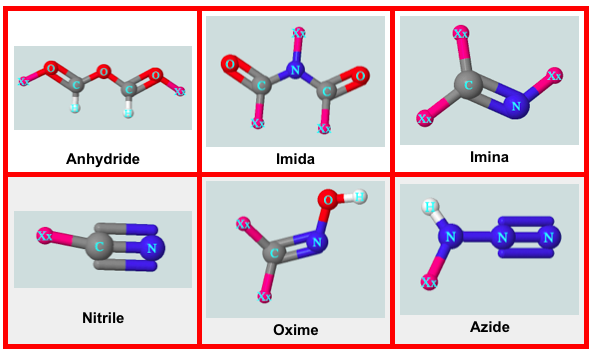
There are a variety of functional groups, here we can see some examples:

Bioprofe | The chemistry of carbon | 29