Matter is made up of tiny units called atoms. We currently know that there are 119 different types of atoms, which are the basis of the 119 elements of the periodic table (including “unnunennio” which is currently being synthesized in Japan).
Chemical elements can form pure substances and mixtures. A pure substance is one which has a composition and characteristic properties that do not change, whatever the physical conditions in which it is found; that is to say, the physical transformations (fusion, boiling …) do not affect it. It is the example of water, whose composition is the same if it is present in solid state, liquid or even gaseous state.
Watch the video:

Pure substances can be classified as:
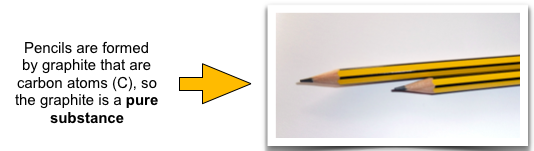
- Simple substance: it is a pure substancie formed by a single type of chemical element. Elements which are known include since common substances such as carbon, iron or silver, to rare substances such as lutetium or thulium.
Bioprofe | Pure substances and mixtures | 01
In nature we can find approximately 90 of these elements. The rest don’t appear naturally and we can only obtain them in an artificially way.
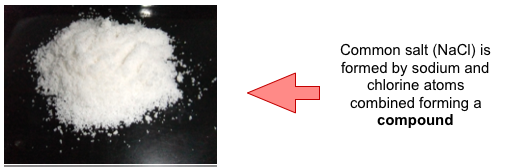
- Compounds: they are substances in which atoms of different elements are combined together. Scientists have identified millions of different chemical compounds. In some cases we can isolate a molecule from a compound. A molecule is the smallest possible entity in which the same proportions of the constituent atoms are maintained as in the chemical compound.
Bioprofe | Pure substances and mixtures | 02
A water molecule is made up of three atoms: two hydrogen atoms attached to a single oxygen atom. A molecule of hydrogen peroxide has two hydrogen atoms and two oxygen atoms; the oxygen atoms are linked together and there is a hydrogen atom attached to each oxygen atom. In contrast, a molecule of the blood protein called “gamma globulin”, is formed by 19996 atoms of only four types: carbon, hydrogen, oxygen and nitrogen.


The composition and properties of an element or compound are uniform anywhere in a given sample, or in different samples of the same element or compound.
When a substance is formed by two or more simple substances, it is known as a mixture, whose properties remain constant but its composition is variable. Through physical processes we can isolate it and obtain the components that make up the mixtures.
Mixtures can be classified as:
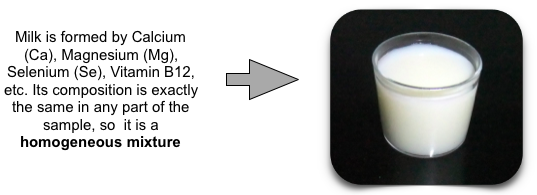
- Homogeneous mixture: whose composition and properties are uniform anywhere in a given sample, but it may vary from one sample to another. A certain aqueous solution of sucrose has a uniform sweetness in any part of the solution, but the sweetness of another sucrose solution can be very different if the proportions of sugar and water are different. Ordinary air is a homogeneous mixture of several gases, mainly with elements such as nitrogen and oxygen.
Bioprofe | Pure substances and mixtures | 03
Sea water is another example of homogeneous mixture due to it is a solution of the compounds water, sodium chloride (salt) and many others. Gasoline is also a homogeneous mixture or dissolution made up of dozens of compounds.
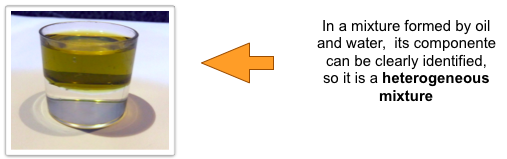
- Heterogeneous mixture: are those in which, at first view, it is easy to identify the different components that make them up. It is the case of the one formed by sand and water, the components are separated in differentiated zones. Therefore, the composition and physical properties vary from one part of the mixture to another.
Bioprofe | Pure substances and mixtures | 04
There are many heterogeneous mixtures that we know as those which are formed by water and alcohol, oil and vinegar, wax and water, etc.
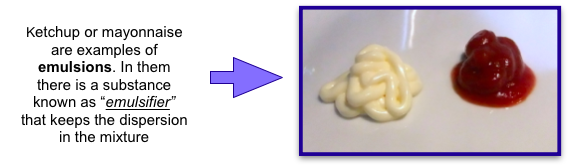
A specific type of heterogeneous mixtures are “colloids” or “colloidal systems”, which can be easily confused with homogeneous mixtures. A colloid is a mixture where the solute, or one of them, are very small particles dispersed in the solvent which are not directly visible, only they are visible at a microscopic level.
Bioprofe | Pure substances and mixtures | 05
Colloids are classified according to the attraction present between the dispersed phase and the continuous phase. The best known colloidal systems are, among others, emulsions, gels, aerosols or foams.


In a general and more visual way we can understand if a substance is pure, homogenous, heterogeneous mixture … thanks to the following scheme:


Bioprofe | Pure substances and mixtures | 06
Separation of mixtures
The components of a mixture can be separated by suitable physical transformations. In the case of a heterogeneous mixture, each of its components retains its characteristic properties which can be used for their separation.
The most commonly used physical procedures are:
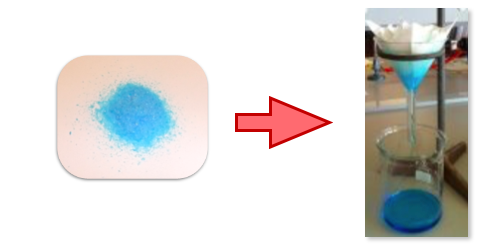
- Filtraion: through this process, we can separate a solid from a liquid in which it is in suspension.
Bioprofe | Sustancias puras y mezclas | 07
- Decantation: procedure to separate two immiscible liquids because one of them is more dense than the other.

Bioprofe | Sustancias puras y mezclas | 08
This process is possible thanks to the separating funnel where after pouring the mixture and wait for a while, we can obtain the lower phase by just opening the valve of the same.
- Magnetic separation: it is used to separate magnetic solid substances such as iron, nickel, cobalt, etc. By the approximation of a magnet to the mixture, a magnetic field is generated, the ferrous compound is attracted to it, while the non-ferrous material remains immovable.
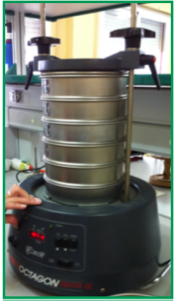
- Sieving: consists of passing a mixture formed by solid particles of different sizes through a sieve or set of sieves. The smaller particles pass through the pores of the sieve through it and the large ones are retained by it. The set of sieves, apparatus known as “sieving machine” can be formed by fixed or moving bars, by perforated plates, or by weaves of metallic threads.
Bioprofe | Sustancias puras y mezclas | 09
The material that passed through a sieve and has been retained by another, because its holes are smaller than the previous one, is usually considered as equal in size to the arithmetical measurement of the openings of both sieves; this value represents the average size or average diameter, and is represented by the symbol Dm.


In the case of homogeneous mixtures, the most used procedures are:
- Crystallization: with the addition of the appropriate solvent, we obtain the crystallization of some of the solutes, while the others remain, as well as the impurities, in the solution.

Bioprofe | Sustancias puras y mezclas | 10
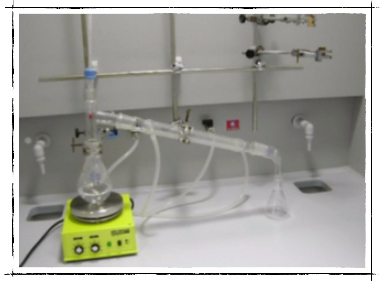
- Destillation: consists of boiling a mixture and then condensing it, by cooling the vapors that have been produced. The separation by the distillation process depends on the fact that the components in the dissolution usually differ in their volatility, that is, how ease they evaporate, in such way that, when the solution is boiling, the vapor that is produced is richer in the more volatile component.
Bioprofe | Sustancias puras y mezclas | 11
- Chromatography: it is based on the different capacity of the compounds to adhere to the surfaces of several solid substances, such as paper or starch.

Bioprofe | Sustancias puras y mezclas | 12
Cromatography is achieved due to the use of two phases: a mobile phase, which is a solution that is composed of different elements; and a stationary phase characterized by being a solid material that remains unchanged after the completion of the technique.
Depending on the nature of the mobile phase and the stationary phase, different types of chromatography can be distinguished: solid-liquid; liquid-liquid; liquid-gas; etc.


Descomposition of compounds
A chemical compound maintains its identity during physical transformations but can be decomposed into its constituent elements through chemical transformations. It is more difficult to carry out the decomposition of a compound in its constituent elements than the mere physical separation of the mixtures.
For example, the extraction of Iron from iron oxide ores requires a blast furnace or the production of Magnesium from Magnesium chloride on an industrial scale requires electricity. Generally, It is easier to convert a compound into other compounds by chemical reaction than to separate a compound into its constituent elements. For example, when ammonium dichromate is heated, it decomposes, forming the substances chromium oxide (III) nitrogen and water.


Bioprofe | Sustancias puras y mezclas | 13
Therefore the most used methods to decompose compounds are:
- By heating: increasing the temperature of the compound.
- By electrolysis: applying electric current to the mixture so that, it decomposes in its different elements.